Over the last few weeks, I’ve seen a lot online about **Recording King shutting down**. Forum posts, YouTube videos, discussions among guitar and banjo players, and plenty of people asking whether it was really happening or if it was just another internet rumor.
Unfortunately, this one appears to be real.
 The Music Link, the company behind Recording King, The Loar, and several other musical instrument brands, has ceased operations.** That means Recording King, at least as we know it today, has shut down.
What Happened?
News started circulating in June that **The Music Link was preparing to cease operations**, and by July the closure was being widely discussed throughout the acoustic guitar, banjo, and bluegrass communities.
The Music Link was the California-based company responsible for Recording King, along with The Loar and Guardian cases. Recording King was probably the best-known name of the bunch, especially among acoustic guitar and banjo players.
For years, Recording King built a reputation around something that has become increasingly difficult to find: **traditional-style instruments at prices regular players could actually afford.** That’s one of the reasons this shutdown bothers me.
Recording King Was Different
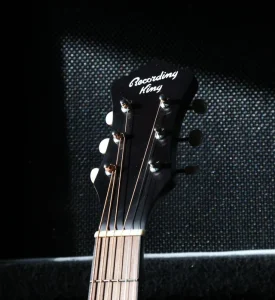 Recording King wasn’t competing with Martin by selling you a $5,000 dreadnought. They weren’t trying to be Taylor, and they weren’t chasing every new high-tech guitar trend. They built guitars that looked backward, and I mean that as a compliment.
Recording King offered dreadnoughts, slope-shoulder guitars, small-body acoustics, resonators, banjos, and other traditional instruments heavily influenced by older American designs. If you liked pre-war-style guitars but didn’t have pre-war-style money, Recording King gave you another option.
You could get solid woods, traditional bracing, vintage-style appointments, and an old-school look without taking out a second mortgage. Were they all perfect? Of course not. Neither are guitars costing three or four times as much. But Recording King managed to build some very respectable instruments for the money.
A Name With Real History
The Recording King name isn’t something dreamed up by a marketing department twenty years ago because somebody thought it sounded old. The name goes back to the **1930s**, when Recording King instruments were sold through Montgomery Ward.
The brand eventually disappeared before being revived decades later by The Music Link. The modern company leaned heavily into that history with vintage designs, traditional construction, old-school headstocks, and instruments that looked like they belonged on a front porch instead of hanging under spotlights in a boutique guitar shop.
That history is part of what made Recording King interesting in the first place.
Why Did The Music Link Shut Down?
This is where I’ve seen plenty of speculation online.
Tariffs have been mentioned. Higher importing costs have been mentioned. The changing musical instrument market has been mentioned. Slowing guitar sales have been mentioned, along with several other theories.
There has also been discussion within the acoustic and bluegrass communities about whether tariffs and overseas manufacturing costs contributed to the company’s problems.
Maybe they did. Maybe several things did.
Businesses rarely close because of one simple reason, and I haven’t seen enough solid information to sit here and pretend I know exactly what caused it.
What we do know is that **The Music Link has ceased operations**, and Recording King has been caught in the middle of it.
What Happens to Recording King Guitars Already Out There?
They’re still guitars.
I know that sounds obvious, but whenever a guitar company shuts down, strange things start happening. Someone will inevitably list a Recording King on Reverb for twice what it cost six months ago and call it **“RARE — PRE-SHUTDOWN RECORDING KING!”**
Give me a break.
Your $700 guitar didn’t magically become a $2,500 collector’s item because the company closed its doors.
Could certain Recording King models become more desirable later? Sure. Models produced in smaller numbers, discontinued instruments, or guitars that already had a strong reputation among players could become harder to find over time.
But that is something the used market will figure out on its own.
If you already own a Recording King that you enjoy playing, my advice is simple: **keep playing it.** That’s what it was built for.
Would I Still Buy One?
If I found a Recording King I liked at a good price, yes.
The company shutting down wouldn’t automatically scare me away from the guitar. I’d look at it the same way I look at any used or discontinued instrument.
How does it sound? How does it play? Is the neck good? Is the construction solid? Does it need anything?
And most importantly, **do I like the damn guitar?**
That’s what matters.
The bigger concern would be things such as factory warranty support or brand-specific replacement parts. If you’re buying new old stock from a dealer, that’s something I would ask about before handing over the money.
Another Loss for the Guitar World
This is the part I don’t like.
The guitar industry needs companies like Recording King. Not everybody wants, or can afford, a $3,000, $4,000, or $5,000 acoustic guitar. You shouldn’t have to spend that much money to own something interesting either.
Companies like Recording King filled the space between inexpensive beginner guitars and the expensive American-made instruments many of us admire but don’t necessarily buy.
That middle ground matters.
Lose enough companies in that part of the market and our choices get smaller. Usually, they get more expensive too.
Gramps Take
I hate seeing another musical instrument company close, especially one like Recording King.
I’ve seen a lot of conversation online about the shutdown, and judging by the reactions, I’m obviously not the only guitar player disappointed by it.
Recording King wasn’t the biggest guitar company. It wasn’t the fanciest. It didn’t have the name recognition of Martin, Gibson, Fender, or Taylor.
But maybe that was part of what made it interesting.
They built traditional instruments for people who actually wanted to **play traditional instruments** without spending a fortune. There’s something to be said for that.
Maybe something happens with the Recording King name down the road. Guitar brands have a funny habit of disappearing and coming back to life.
But as I’m writing this, **The Music Link has closed its doors, and the Recording King we knew is gone.**
That’s a shame, because we don’t need fewer companies making interesting, affordable guitars.
We need more of them.
— Gramps
